Mathematics at Harper Bell – Teaching to the Top
At Harper Bell, we use a Teaching to the Top approach in mathematics, which is rooted in high expectations and the belief that every child can succeed in maths. Closely linked to the Maths Mastery approach, this way of teaching ensures that all pupils are challenged, supported and given access to rich mathematical thinking.
Rather than rushing through topics or separating children by perceived ability, we teach mathematics through whole‑class lessons, where everyone learns together. Concepts are explored in depth, using clear explanations, accurate mathematical language and carefully chosen examples, so children understand not just how to solve a problem, but why it works.
What Does Teaching to the Top Mean?
-
High expectations for all
We believe every child can achieve a deep understanding of maths. Teachers continually raise expectations and provide the right support so that no one is left behind. -
Deep understanding, not just methods
Children learn the meaning behind mathematical ideas, helping them make sense of their learning and apply it confidently. -
Whole‑class interactive teaching
Lessons involve questioning, discussion and short tasks that allow all children to think, respond and explain their ideas. -
Addressing gaps quickly
Teachers carefully check understanding and address misconceptions straight away, ensuring learning builds securely over time. -
Fluency through understanding
Children develop quick recall of key number facts and methods so they can concentrate on more challenging problem‑solving.
How This Looks in the Classroom
-
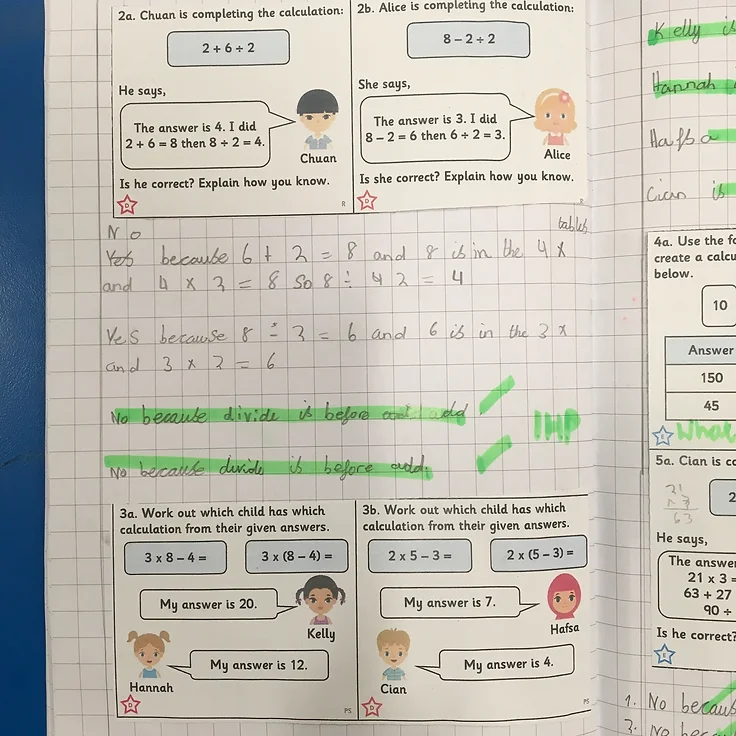
Reasoning and explaining
Children are encouraged to talk about their thinking, explain their answers and use mathematical vocabulary confidently. -
Depth before speed
We focus on mastering concepts thoroughly rather than hurrying through content. -
Making connections
Teachers use practical resources, pictures and symbols (Concrete, Pictorial, Abstract) to build strong and lasting understanding. -
Developing independence
Pupils are supported to become confident problem‑solvers who take pride in their learning.
Why This Approach Matters
-
Reduces overload
Secure number facts free up children’s thinking so they can tackle more complex problems. -
Builds confidence and enjoyment
Understanding maths deeply makes learning more meaningful and engaging. -
Develops resilience
Children learn that challenge is part of learning and develop perseverance when problem‑solving.
Evidence of Impact on Pupil Learning
Ofsted - September 2018
Senior leaders have taken swift action to improve teachers’ subject knowledge in mathematics.
Mathematics lessons have a structure that provides daily opportunities for pupils to practise and refine calculation skills and to solve mathematical problems.
In 2018, pupils’ attainment in mathematics was above the national average at the expected standard.